
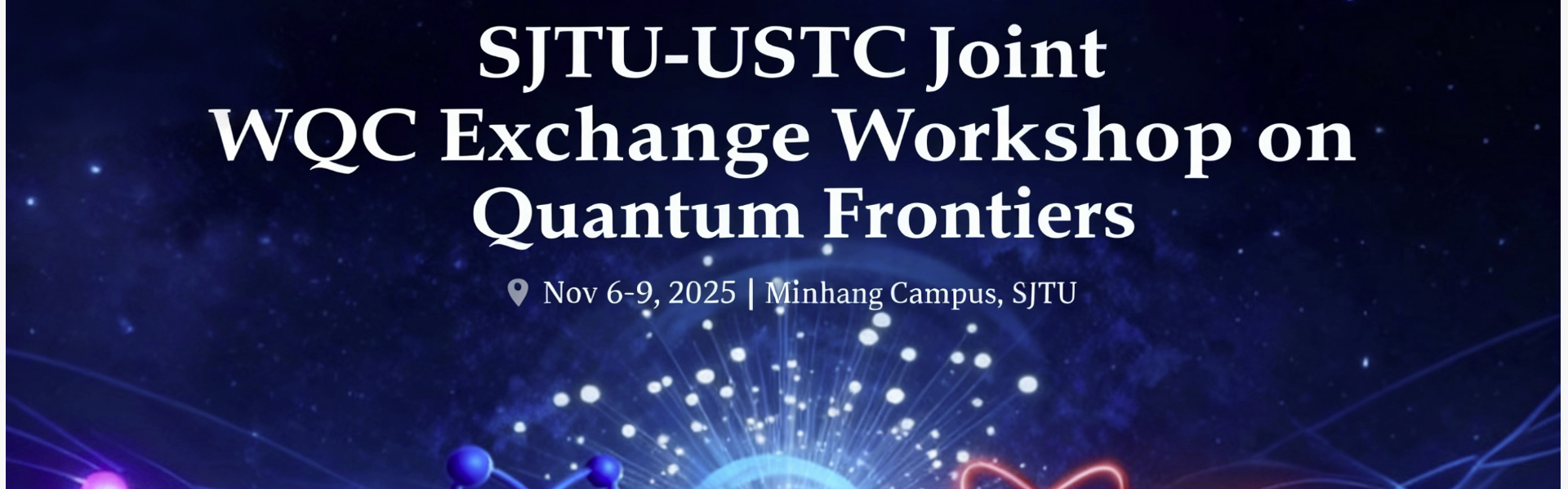
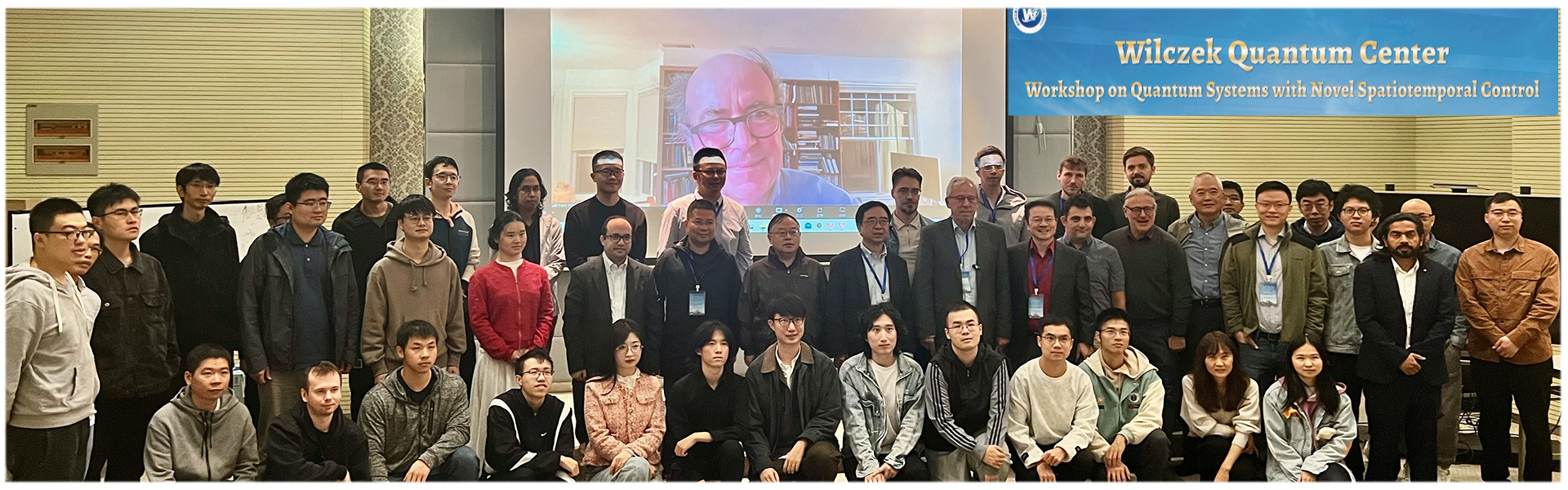
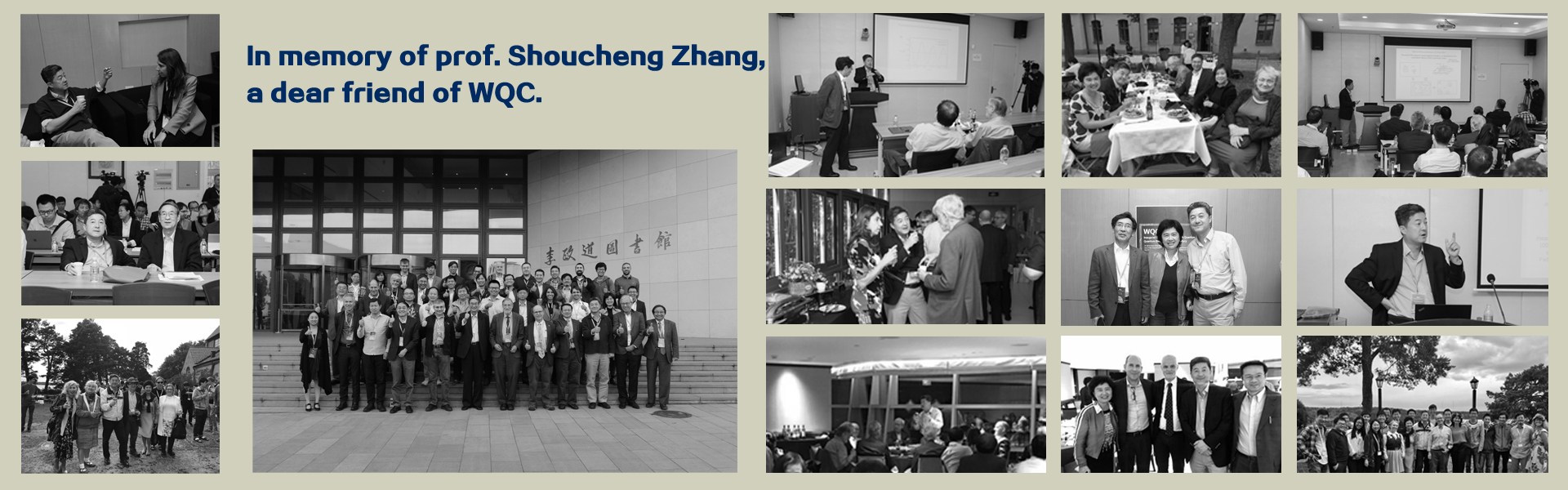

From November 6 to 9, 2025, the SJTU-USTC Joint WQC Exchange Workshop on Quantum Frontiers successfully unfolded at the SJTU Academic Activity Center (Minhang Campus) and the Wilczek Quantum Center (SPA). Co-organized by the Wilczek Quantum Centers (WQC) at Shanghai Jiao Tong University (SJTU)’s School of Physics and Astronomy (SPA) and the Shanghai Institute for Advanced Studies (SIAS) of the University of Science & Technology of China (USTC), this four-day event gathered top researchers, students, and postdocs in the quantum science community to explore cutting-edge frontiers and foster cross-institutional collaboration.
The workshop kicked off with a registration session, where participants from SJTU, USTC, and renowned institutions worldwide, such as the University of Pittsburgh, University of Hamburg, and Nordita, checked in and prepared for the upcoming academic exchanges. The smooth registration process, facilitated by supporting staff from both universities, laid a solid foundation for the event’s success.
Friday’s agenda featured a rich lineup of invited talks, hot topic presentations, and interactive activities, centered at the SJTU Academic Activity Center-Lecture Hall. The day began with a grand opening ceremony attended by Prof. Dong Qian, followed by a welcome speech and a profound quantum research talk by Frank Wilczek, which set a high academic tone for the workshop.
Zi Cai from SJTU delivered an invited talk on “Emergent physics in non-equilibrium frustrated magnetism,” shedding light on novel phenomena in complex magnetic systems. The hot topic session, chaired by Biao Wu, showcased cutting-edge research: Igor Ermakov explored “Taking Operator Growth Beyond Pauli Strings: Qudits and Fermions,” while Xinyang Yu presented “Squeezing atomic p-orbital condensates for detecting gravitational waves,” sparking lively discussions among attendees.
After lunch, a special session titled “WQC History and Accomplishment” brought together Vincent Liu, Antti Niemi, Biao Wu, and Xiangjun Xing, who reflected on the WQC’s development journey and academic achievements, offering valuable insights for young researchers. The afternoon concluded with a tour of the SJTU Museum, allowing participants to immerse themselves in the university’s profound cultural heritage. The day ended with a banquet at LiuYuan Restaurant, providing a relaxed atmosphere for attendees to network and strengthen professional bonds.


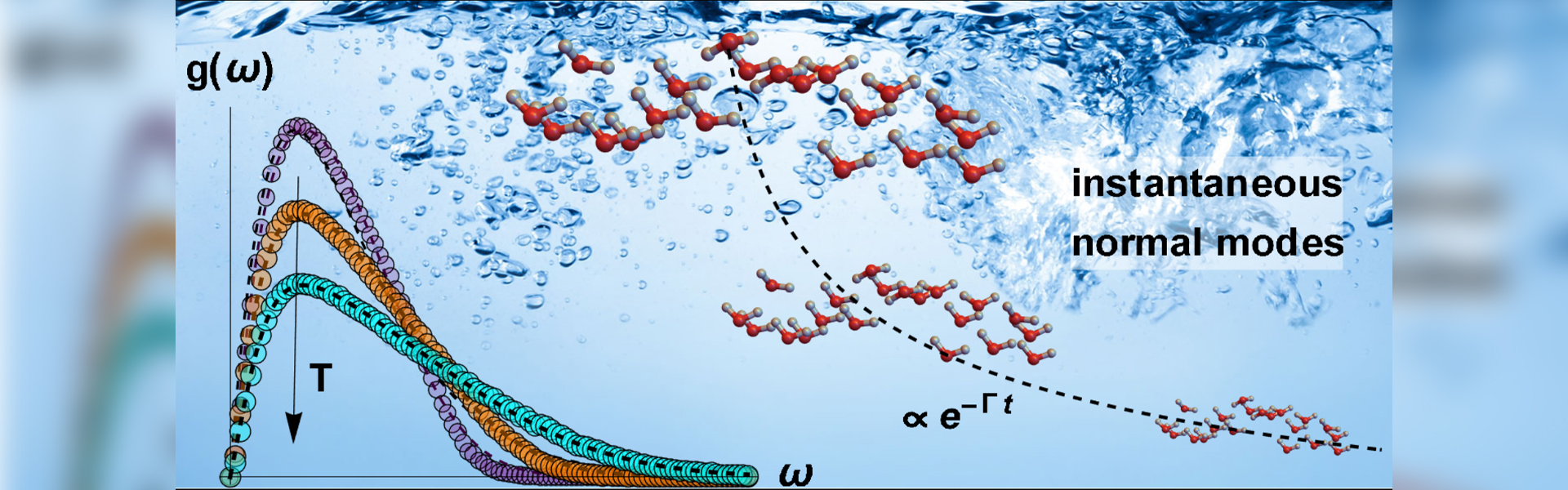
Saturday’s activities shifted to Room 203 of No.5 Science Building and the WQC Hall, with sessions focusing on specialized research directions and interactive poster exchanges. The morning invited talks covered diverse topics: Fattah Sakuldee from SJTU shared research on “Synchronous manipulation of nuclear spins via boron vacancy centers in hexagonal boron nitride,” while Matteo Baggioli discussed “The origins of viscosity: from atomic motion to fluid resistance,” bridging the gap between microscopic physics and macroscopic phenomena.
The hot topic session, chaired by Ke Liu, featured Shu Tian’s presentation on “Z2 lattice gauge theory on non-trivial topology and its quantum simulation” and Zhiqiang Wang’s talk on “Molecular superfluid and interactions near a Feshbach resonance of bosonic atoms,” highlighting breakthroughs in quantum simulation and superfluid research.
The afternoon’s poster session at the WQC Hall (8th floor of No.5 Science Building) was a highlight of the day. Students and postdocs presented their latest research findings through vivid posters, engaging in in-depth one-on-one discussions with peers and senior researchers. This interactive format not only showcased the vitality of young scholars but also facilitated the exchange of innovative ideas and potential collaborative opportunities.

The final day of the workshop focused on concluding academic sharing and closing remarks, held in Room 203 of No.5 Science Building. Xiangjun Xing from SJTU delivered an invited talk on “Epistemic lens and epistemic irreversibility: a minimal thermodynamic theory of awareness,” exploring the intersection of quantum physics and thermodynamics. Qijin Chen from USTC presented “Understanding the pseudogap in a unitary Fermi gas: A spectral study of the effect of pairing fluctuations,” offering new perspectives on strongly correlated systems.
The workshop concluded with a closing remark by Antti Niemi, who summarized the key achievements of the four-day event, emphasized the value of cross-institutional collaboration, and expressed expectations for future academic exchanges in the quantum science field. After the session, participants completed hotel check-out, marking the successful conclusion of the workshop.
This workshop covered a broad spectrum of quantum science research, including quantum matter theory, quantum optics, quantum information, cold atom physics, and quantum computing algorithms. The combination of invited talks, hot topic presentations, and poster sessions ensured in-depth exploration of both foundational and cutting-edge issues. Special emphasis on rapidly developing directions, such as ultracold atoms in novel lattices, low-dimensional synthetic quantum materials, and quantum simulation beyond the Standard Model, provided attendees with a comprehensive overview of the field’s latest trends.
